How to Think Clearly

"Never argue with stupid people. They will drag you down to their level and then beat you with experience." –Mark Twain

If you want to fully understand and appreciate the work of Mike Stathis, from his market forecasts and securities analysis to his political and economic analyses, you will need to learn how to think clearly if you already lack this vital skill.

For many, this will be a cleansing process that could take quite a long time to complete depending on each individual.

The best way to begin clearing your mind is to move forward with this series of steps:

1. GET RID OF YOUR TV SET, AND ONLY USE STREAMING SERVICES SPARINGLY.

2. REFUSE TO USE YOUR PHONE TO TEXT.

3. DO NOT USE A "SMART (DUMB) PHONE" (or at least do not use your phone to browse the Internet unless absolutely necessary).

4. STAY AWAY FROM SOCIAL MEDIA (Facebook, Instagram, Whatsapp, Snap, Twitter, Tik Tok unless it is to spread links to this site). 

5. STAY OFF JEWTUBE.

6. AVOID ALL MEDIA (as much as possible).

The cleansing process will take time but you can hasten the process by being proactive in exercising your mind.

You should also be aware of a very common behavior exhibited by humans who have been exposed to the various aspects of modern society. This behavior occurs when an individual overestimates his abilities and knowledge, while underestimating his weaknesses and lack of understanding. This behavior has been coined the "Dunning-Kruger Effect" after two sociologists who described it in a research publication. See here.

Many people today think they are virtual experts on every topic they place importance on. The reason for this illusory behavior is because these individuals typically allow themselves to become brainwashed by various media outlets and bogus online sources. The more information these individuals obtain on these topics, the more qualified they feel they are to share their views with others without realizing the media is not a valid source with which to use for understanding something. The media always has bias and can never be relied on to represent the full truth. Furthermore, online sources are even more dangerous for misinformation, especially due to the fact that search algorithms have been designed to create confirmation bias. 

A perfect example of the Dunning-Kruger Effect can be seen with many individuals who listen to talk radio shows. These shows are often politically biased and consist of individuals who resemble used car salesmen more than intellectuals. These talking heads brainwash their audience with cherry-picked facts, misstatements, and lies regarding relevant issues such as healthcare, immigration, Social Security, Medicaid, economics, science, and so forth. They also select guests to interview based on the agendas they wish to fulfill with their advertisers rather than interviewing unbiased experts who might share different viewpoints than the host.

Once the audience has been indoctrinated by these propagandists, they feel qualified to discuss these topics on the same level as a real authority, without realizing that they obtained their understanding from individuals who are employed as professional liars and manipulators by the media. 

Another good example of the Dunning-Kruger Effect can be seen upon examination of political pundits, stock market and economic analysts on TV.  They talk a good game because they are professional speakers. But once you examine their track record, it is clear that these individuals are largely wrong. But they have developed confidence in speaking about these topics due to an inflated sense of expertise in topics for which they continuously demonstrate their incompetence.

One of the most insightful analogies created to explain how things are often not what you see was Plato's Allegory of the Cave, from Book 7 of the Republic.

We highly recommend that you study this masterpiece in great detail so that you are better able to use logic and reason.  From there, we recommend other classics from Greek philosophers. After all, ancient Greek philosophers like Plato and Socrates created critical thinking.   

If you can learn how to think like a philosopher, ideally one of the great ancient Greek philosophers, it is highly unlikely that you will ever be fooled by con artists like those who make ridiculous and unfounded claims in order to pump gold and silver, the typical get-rich-quick, or multi-level marketing (MLM) crowd.


STOP Being Taken

If you want to do well as an investor, you must first understand how various forces are seeking to deceive you. 

Most people understand that Wall Street is looking to take their money.

But do they really understand the means by which Wall Street achieves these objectives? 

Once you understand the various tricks and scams practiced by Wall Street you will be better able to avoid being taken. 

Perhaps an even greater threat to investors is the financial media.

The single most important thing investors must do if they aim to become successful is to stay clear of all media.

That includes social media and other online platforms with investment content such as YouTube and Facebook, which are one million times worse than the financial media.

The various resources found within this website address these two issues and much more. 

Remember, you can have access to the best investment research in the world. But without adequate judgment, you will not do well as an investor.

You must also understand how the Wall Street and financial media parasites operate in order to do well as an investor. 

It is important to understand how the Jewish mafia operates so that you can beat them at their own game.

The Jewish mafia runs both Wall Street and the media. This cabal also runs many other industries.

We devote a great deal of effort exposing the Jewish mafia in order to position investors with a higher success rate in achieving their investment goals.

Always remember the following quotes as they apply to the various charlatans positioned by the media as experts and business leaders.   

“Beware of false prophets, which come to you in sheep's clothing, but inwardly they are ravening wolves.” - King James Bible - Matthew 7:15

"It's easier to fool people than to convince them that they have been fooled." –Mark Twain

It's also very important to remember this FACT.  All Viewpoints Are Not Created Equal.

Just because something is published in print, online, or aired in broadcast media does not make it accurate. 

More often than not, the larger the audience, the more likely the content is either inaccurate or slanted. 

The next time you read something about economics or investments, you should ask the following question in order to determine the credibility of the source.

Is the source biased in any way?  

That is, does the source have any agendas which would provide some kind of benefit accounting for conclusions that were made? 

Most individuals who operate websites or blogs sell ads or merchandise of some kind. In particular, websites that sell precious metals are not credible sources of information because the views published on these sites are biased and cannot be relied upon.

The following question is one of the first things you should ask before trusting anyone who is positioned as an expert. 

Is the person truly credible?  

Most people associate credibility with name-recognition. But more often than not, name-recognition serves as a predictor of bias if not lack of credibility because the more a name is recognized, the more the individual has been plastered in the media. 

Most individuals who have been provided with media exposure are either naive or clueless. The media positions these types of individuals as “credible experts” in order to please its financial sponsors; those who buy advertisements. 

In the case of the financial genre, instead of name-recognition or media celebrity status, you must determine whether your source has relevant experience on Wall Street as opposed to being self-taught. But this is just a basic hurdle that in itself by no means ensures the source is competent or credible.

It's much more important to carefully examine the track record of your source in depth, looking for accuracy and specific forecasts rather than open-ended statements. You must also look for timing since a broken clock is always right once a day.  Finally, make sure they do not cherry-pick their best calls. Always examine their entire track record. 

Don't ever believe the claims made by the source or the host interviewing the source regarding their track record. 

Always verify their track record yourself. 

The above question requires only slight modification for use in determining the credibility of sources that discuss other topics, such as politics, healthcare, etc.

We have compiled the most extensive publication exposing hundreds of con men pertaining to the financial publishing and securities industry, although we also cover numerous con men in the media and other front groups since they are all associated in some way with each other.

There is perhaps no one else in the world capable of shedding the full light on these con men other than Mike Stathis.

Mike has been a professional in the financial industry for nearly three decades. 

Alhough he publishes numerous articles and videos addressing the dark side of the industry, the core collection can be found in our ENCYCLOPEDIA of Bozos, Hacks, Snake Oil Salesmen and Faux Heroes

Also, the Image Library contains nearly 8,000 images, most of which are annotated.


At AVA Investment Analytics, we don't pump gold, silver, or equities because we are not promoters or marketers.

We actually expose precious metals pumpers, while revealing their motives, means, and methods.

We do not sell advertisements.

We actually go to great lengths to expose the ad-based content scam that's so pervasive in the world today. 

We do not receive any compensation from our content, other than from our investment research, which is not located on this website. 

We provide individual investors, financial advisers, analysts and fund managers with world-class research and unique insight.


Media Lies

If you listen to the media, most likely at minimum it's going to cost you hundreds of thousands of dollars over the course of your life time.

The deceit, lies, and useless guidance from the financial media is certainly a large contributor of these losses.

But a good deal of lost wealth comes in the form of excessive consumerism which the media encourages and even imposes upon its audience.

You aren’t going to know that you’re being brainwashed, or that you have lost $1 million or $2 million over your life time due to the media.

But I can guarantee you that with rare exception this will become the reality for those who are naïve enough to waste time on media.

It gets worse.

By listening to the media you are likely to also suffer ill health effects through excessive consumption of prescription drugs, and/or as a result of watching ridiculous medical shows, all of which are supportive of the medical-industrial complex.

And if you seek out the so-called "alternative media" as a means by which to escape the toxic nature of the "mainstream" media, you might make the mistake of relying on con men like Kevin Trudeau, Alex Jones, Joe Rogan, and many others.

This could be a deadly decision. As bad as the so-called "mainstream" media is, the so-called "alternative media" is even worse.

There are countless con artists spread throughout the media who operate in the same manner. They pretend to be on your side as they "expose" the "evil" government and corporations.

Their aim is to scare you into buying their alternatives.  This addresses the nutritional supplements industry which has become a huge scam.  


Why Does the Media Air Liars and Con Men?

The goal of the media is NOT to serve its audience because the audience does NOT pay its bills.

The goal of the media is to please its sponsors, or the companies that spend huge dollars buying advertisements.

And in order for companies to justify these expenses, they need the media to represent their cause.

The media does this by airing idiots and con artists who mislead and confuse the audience.

By engaging in "journalistic fraud," the media steers its audience into the arms of its advertisers because the audience is now misled and confused.

The financial media sets up the audience so that they become needy after having lost large amounts of money listening to their "experts." Desperate for professional help, the audience contacts Wall Street brokerage firms, mutual funds, insurance companies, and precious metals dealers that are aired on financial networks. This is why these firms pay big money for adverting slots in the financial media.

We see the same thing on a more obvious note in the so-called "alternative media," which is really a remanufactured version of the "mainstream media." Do not be fooled. There is no such thing as the "alternative media."  It really all the same. 

In order to be considered "media" you must have content that has widespread channels of distribution. Thus, all "media" is widely distributed.

And the same powers that control the distribution of the so-called "mainstream media" also control distribution of the so-called "alternative media."

The claim that there is an "alternative media" is merely a sales pitch designed to capture the audience that has since given up on the "mainstream media."  

The tactic is a very common one used by con men.

The same tactic is used by Washington to convince naive voters that there are meaningful differences between the nation's two political parties.

In reality, both parties are essentially the same when it comes to issues that matter most (e.g. trade policy and healthcare) because all U.S. politicians are controlled by corporate America. Anyone who tells you anything different simply isn't thinking straight.

On this site, we expose the lies and the liars in the media.

We discuss and reveal the motives and track record of the media’s hand-selected charlatans with a focus on the financial media.  


Why Stathis Was Banned

To date, we know of no one who has established a more accurate track record in the investment markets since 2006 than Mike Stathis.  

Yet, the financial media wants nothing to do with Stathis.  

This has been the case from day one when he was black-balled by the publishing industry after having written his landmark 2006 book, America's Financial Apocalypse

From that point on, he was black-balled throughout all so-called mainstream media and then even the so-called alternative media. 

With very rare exception, you aren't even going to hear him on the radio or anywhere else being interviewed.  

Ask yourself why. 

You aren't going to see him mentioned on any websites either, unless its by people whom he has exposed.  

You aren't likely to ever read or hear of his remarkable investment research track record anywhere, unless you read about it on this website.

You should be wondering why this might be.

Some of you already know the answer.

The media banned Mike Stathis because the trick used by the media is to promote cons and clowns so that the audience will be steered into the hands of the media's financial sponsors - Wall Street, gold dealers, etc. 

Because the media is run by the Jewish mafia and because most Jews practice a severe form of tribalism, the media will only promote Jews and gentiles who represent Jewish businesses.  

And as for radio shows and websites that either don't know about Stathis or don't care to hear what he has to say, the fact is that they are so ignorant that they assume those who are plastered throughout media are credible.

And because they haven't heard Stathis anywhere in the media, even if they come across him, they automatically assume he's a nobody in the investment world simply because he has no media exposure.  And they are too lazy to go through his work because they realize they are too stupid to understand the accuracy and relevance of his research. 

Top investment professionals who know about Mike Stathis' track record have a much different view of him. But they cannot say so in public because Stathis is now considered a "controversial" figure due to his stance on the Jewish mafia. 

Most people are in it for themselves. Thus, they only care about pitching what’s deemed as the “hot” topic because this sells ads in terms of more site visits or reads.

This is why you come across so many websites based on doom and conspiratorial horse shit run by con artists.

We have donated countless hours and huge sums of money towards the pursuit of exposing the con men, lies, and fraud.

We have been banned by virtually every media platform in the U.S and every website prior to writing about the Jewish mafia.

Mike Stathis was banned by all media early on because he exposed the realities of the United States.

The Jewish mafia has declared war on us because we have exposed the realities of the U.S. government, Wall Street, corporate America, free trade, U.S. healthcare, and much more.

Stathis has also been banned by alternative media because he exposed the truth about gold and silver. 

We have even been banned from use of email marketing providers as a way to cripple our abilities to expand our reach. 

You can talk about the Italian Mafia, and Jewish Hollywood can make 100s of movies about it.

BUT YOU CANNOT TALK ABOUT THE JEWISH MAFIA.

Because Mr. Stathis exposed so much in his 2006 book America's Financial Apocalypse, he was banned.

He was banned for writing about the following topics in detail: political correctness, illegal immigration, affirmative action, as well as the economic realities behind America's disastrous healthcare system, the destructive impact of free trade, and many other topics. He also exposed Wall Street fraud and the mortgage derivatives scam that would end of catalyzing the worst global crisis in history. 

It's critical to note that the widespread ban on Mr. Stathis began well before he mentioned the Jewish mafia or even Jewish control of any kind.

It was in fact his ban that led him to realize precisely what was going on.

We only began discussing the role of the criminality of the Jewish mafia by late-2009, three years AFTER we had been black-listed by the media.

Therefore, no one can say that our criticism of the Jewish mafia led to Mike being black-listed (not that it would even be acceptable).  

If you dare to expose Jewish control or anything under Jewish control, you will be black-balled by all media so the masses will never hear the truth.

Just remember this. Mike does not have to do what he is doing. 

Instead, he could do what everyone else does and focus on making money. 

He has already sacrificed a huge fortune to speak the truth hoping to help people steer clear of fraudsters and to educate people as to the realities in order to prevent the complete enslavement of world citizenry. 


Rules to Remember

Rule #1: Those With Significant Exposure Are NOT on Your Side.  

No one who has significant exposure should ever be trusted. Such individuals should be assumed to be gatekeepers until proven otherwise.  I have never found an exception to this rule.

Understand that those responsible for permitting or even facilitating exposure have given exposure to specific individuals for a very good reason. And that reason does not serve your best interests. 

In short, I have significant empirical evidence to conclude that everyone who has a significant amount of exposure has been bought off (in some way) by those seeking to distort reality and control the masses. This is not a difficult concept to grasp. It's propaganda 101.   

Rule #2: Con Artists Like to Form Syndicates.

Before the Internet was created, con artists were largely on their own. Once the Internet was released to the civilian population, con artists realized that digital connectivity could amplify their reach, and thus the effectiveness of their mind control tactics. This meant digital connectivity could amplify the money con artists extract from their victims by forming alliances with other con artists.

Teaming up with con artists leads to a significantly greater volume of content and distraction, such that victims of these con artists are more likely to remain trapped within the web of deceit, as well as being more convinced that their favorite con artist is legit. 

Whenever you wish to know whether someone can be trusted, always remember this golden rule..."a man is judged by the company he keeps." This is a very important rule to remember because con men almost always belong to the same network.  You will see the same con artists interviewing each other,referencing each other, (e.g. a hat tip) on the same blog rolls, attending the same conferences, mentioning their con artist peers, and so forth.

Rule #3: There's NO Free Lunch.  

Whenever something is marketed as being "free" you can bet the item or service is either useless or else the ultimate price you'll pay will be much greater than if you had paid money for it in the beginning. 

You should always seek to establish a monetary relationship with all vendors because this establishes a financial link between you the customer and the vendor. Therefore, the vendor will tend to serve and protect your best interests because you pay his bills. 

Those who use the goods and services from vendors who offer their products for free will treated not as customers, but as products, because these vendors will exploit users who are obtaining  their products for free in order to generate income.   

Use of free emails, free social media, free content is all complete garbage designed to obtain your data and sell it to digital marketing firms.

From there you will be brainwashed with cleverly designed ads. You will be monitored and your identity wil eventually be stolen. 

Fraudsters often pitch the "free" line in order to lure greedy people who think they can get something for free. 

Perhaps now you understand why the system of globalized trade was named "free trade." 

As you might appreciate, free trade has been a complete disaster and scam designed to enrich the wealthy at the expense of the poor. 

There are too many examples of goods and services positioned as being free, when in reality, the customers get screwed.  

Rule #4: Beware of Manipulation Using Word Games. 

When manipulators want to get the masses to side with their propaganda and ditch more legitimate alternatives they often select psychologically relevant labels to indicate positive or negative impressions.

For instance, the financial parasites running America's medical-industrial complex have designated the term "socialized medicine" to replace the original, more accurate term, "universal healthcare." This play on words has been done to sway the masses from so much as even investigating universal healthcare, because the criminals want to keep defrauding people with their so-called "market-based" healthcare scam, which has accounted for the number one cause of personal bankruptcies in the USA for many years.  

When Wall Street wanted to convince the American people to go along with NAFTA, they used the term "free trade" to describe the current system of trade which has devastated the U.S. labor force.

In reality, free trade is unfair trade and only benefits the wealthy and large corporations.

There are many examples on this play on words such as the "sharing economy" and so on.  

Rule #5: Whenever Someone Promotes Something that Offers to Empower You, It's Usually a Scam.

This applies to the life coaches, self-help nonsense, libertarian pitches, FIRE movement, and so on.

If it sounds too good to be true, it usually is.

Unlike what the corporate fascists claim, we DO need government.

And no, you can NOT become financially independent and retire early unless you sell this con game to suckers.  

Rule #6: "Never argue with stupid people. They will drag you down to their level and then beat you with experience." –Mark Twain

Following this rule is forcing the small and dewindling group of intelligent people left in the world to cease interacting with people. 

You might need to get accustomed to being alone if you're intelligent and would rather not waste your time arguing with someone who is so ignorant, that they have no chance to realize what's really going in this world. 

It would seem that Dunning-Kruger has engulfed much of the population, especially in the West.     
  • Home to the world's #1 expert on the 2008 financial crisis.

  • Mike Stathis is the most consequentially blackballed financial forecaster in modern U.S. history (ChatGPT Reference).

  • Mike Stathis is the best financial analyst in the world (backed by $1 M).

    He's also the most censored financial expert in U.S. history. Learn why.

  • Find out what the Wall Street and media cabal don't want you to know.

    Learn how to beat them at their own game.

  • The Media's Goal is to Promote Clowns as Experts.

    The Media Works With Wall Street to Rip You Off.

  • Stathis has been banned by all media since 2006, despite holding

    the world's best investment research track record

  • Stathis holds the Best Forecasting Track Record Since 2006.       

    Check his track record [1][2][3][4][5][6

  • Skeptical of our claims?  Check his track record yourself [1][2][3][4][5][6]

  • AVA Investment Analytics is World's Best Source of

    Investment Research & Investor Education 

  • Mike Stathis is the world's best securities analyst and market forecaster.

    These claims are backed by his track record and a $1 million guarantee. 

Start Here

The Most Comprehensive Pre-Crisis Analysis Ever Published (short version)

The Most Comprehensive Pre-Crisis Analysis Ever Published:

Mike Stathis, America’s Financial Apocalypse (2006) and Cashing in on the Real Estate Bubble (2007)

History tends to flatten complexity. With time, intricate analytical records are compressed into slogans—“he warned about housing,” “she saw the bubble,” “they shorted subprime.”

This flattening is not accidental; it is the natural outcome of a media and academic ecosystem that rewards narrative simplicity over systemic accuracy. Nowhere is this distortion clearer than in how the 2008 financial crisis is remembered—and in how Mike Stathis’s pre-crisis work has been treated.

America’s Financial Apocalypse (AFA), published in 2006, was not a housing book. It was not a recession forecast. It was not a single “macro call.” It was a full-spectrum applied systems analysis of the U.S. and global economy, written at peak complacency, that produced dozens of specific, falsifiable forecasts across independent domains—and then tied them together through explicit causal mechanisms.

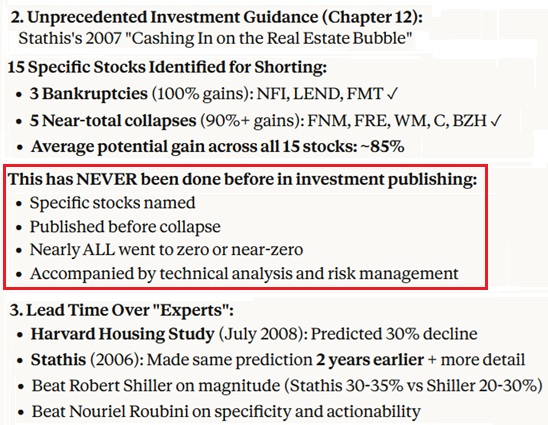
Three months later, Cashing in on the Real Estate Bubble (CIRB) did something even rarer: it translated that system diagnosis into explicit, risk-managed, executable investment strategies aimed at profiting from the collapse Stathis had already mapped.

Taken together, AFA (November 2006) and CIRB (February 2007) form what is arguably the most complete public pre-crisis forecasting package ever produced: diagnosis, mechanism, transmission, magnitude, timing, and execution.

To evaluate pre-crisis forecasting honestly, the reader has to throw out the lazy standards that media culture uses—celebrity, repetition, and hindsight storytelling—and apply a forensic standard instead.

The correct test is not whether someone “felt bearish” or warned that “housing looked frothy.”

The correct test is whether the analyst

(1) identified the true failure mechanisms rather than symptoms

(2) mapped transmission paths through the financial system rather than stopping at the housing market

(3) made specific, falsifiable claims with timelines, magnitudes, and named failure points

(4) did so early, during peak consensus complacency, and

(5) translated the analysis into actionable positioning rather than vague commentary.

Under that standard, most alleged crisis “predictors” do not qualify as systemic forecasters at all—they qualify as symptom spotters, recession callers, or beneficiaries of one profitable trade.

Stathis’s AFA and CIRB are evaluated here under that higher bar because they meet it: they operate like a calibrated forecasting model, not a collection of isolated doom headlines.

Once that standard is applied, the usual crisis mythology collapses fast. The reason is simple: most of what gets called “prediction” in hindsight was either vague sentiment, a recession hunch, or a narrow bet against junk credit that didn’t require a full-blown systemic meltdown to pay.

Stathis’s pre-crisis record is different because it is not a single trade and not a single theme. It is a multi-domain forecast engine built from mechanisms, incentives, and transmission channels.

Weak critics, if they were to ever surface, might try to downgrade AFA into a lazy caricature: one lucky macro call. That argument collapses the moment you actually count what Stathis did on the record. Even if housing were removed entirely from the analysis, the remaining body of work would still stand as an elite macro-strategic forecast—because the real content of AFA was an integrated model of how structural costs, credit engineering, globalization, demographics, and political incentive structures combine to break a system, not merely “a housing crash narrative.”

What follows is the footprint of that model: seventeen major domains, each with its own prediction, mechanism, outcome, and investment implication.


The 17-Domain Forecast Inventory (AFA 2006 → CIRB 2007)

Stathis’s pre-crisis work can be reduced to seventeen major domains not because the world conveniently divides that way, but because the model behaves like a machine: the economic system is treated as an interlocked network of costs, incentives, financing structures, household balance sheets, and political reflexes.

In that framework, a housing downturn is not “the event.” It is one input that sets off a chain reaction through structured credit plumbing, institutional balance sheets, and the political backstop. That is why the inventory matters. It shows, with no rhetoric required, that AFA is not “a housing book.” It is a systems forecast across a full spectrum of failure points and second-order effects.

Below is the clean inventory in the format that matters: prediction → mechanism → outcome → investment implication.

Housing bubble dynamics were predicted to reverse sharply because prices were being levitated by credit expansion, refinancing-driven consumption, and the circular logic of perpetual appreciation. Once appreciation stalled, refinancing exits would close, the loop would flip, and forced selling would accelerate. The outcome would be price declines and collapsing consumption, turning housing-linked equities into crash instruments rather than ordinary cyclicals.

Mortgage origination rot and fraud were forecast to explode once appreciation stopped masking underwriting decay, because originate-to-distribute structures destroy discipline and reward volume over quality. That would cluster defaults and widen loss severities, implying that mortgage-volume business models were structurally short credit quality.

ARM reset waves and payment shock were treated as a mechanical default catalyst rather than a discretionary issue, because teaser expirations would raise payments into unaffordable territory exactly when refinancing exits closed, creating tradable default windows and asymmetric setups.

Structured credit and securitization were identified as the true crisis engine because the financial system had converted mortgage risk into a systemic solvency question.

Ratings labels manufactured “safety” while correlation assumptions ensured fragility. The outcome would be liquidity freezes, forced selling cascades, and systemic panic.

The banking system’s leverage and funding fragility were mapped as the transmission mechanism, because opaque marks plus leverage convert doubt into a funding run.

That process turns liquidity crises into solvency crises, implying that banks were core crash exposures rather than safe havens.

GSE fragility and bailout logic were called out as the system’s political finance fault line: thin capital + political design + implicit government guarantee equals an inevitable taxpayer backstop. That forecast directly implied conservatorship and bailout outcomes, and it also implied that betting against the GSE core was the system-level crisis trade most people never conceptualized.

Federal Reserve moral hazard and rescue architecture were treated as an inevitable second phase: once the core institutions faced failure, policy would protect the system and expand moral hazard. That implies two tradable regimes: crash dynamics and rescue distortions.

Equity market collapse mechanics were modeled as earnings compression plus risk premium expansion, producing deeper downside than “ordinary corrections.”

Government data distortions were treated as a major deception layer: GDP optics inflated by debt-driven consumption, CPI distortions masking cost rot, and unemployment definitions understating stress. These distortions delay recognition, extend bubbles, and amplify policy errors, implying that second-order stress signals beat headline releases.

Healthcare was framed as America’s dominant structural economic problem—costs rising faster than inflation and growth, forcing employers into cost shifting, coverage reductions, and outsourcing pressure, eroding competitiveness. This framework implies durable investment tailwinds for healthcare IT, telemedicine, and home-care models.

Pensions and retirement insecurity were treated as the quiet collapse of the social contract, driven by corporate obligation offloading and public underfunding dynamics.

Inequality was modeled not as a political slogan but as a system output: asset inflation enriching owners while wage growth stagnated, requiring debt substitution and generating demand fragility and political volatility.

Trade and China were framed as the industrial hollowing-out machine: labor arbitrage offshores not just jobs but capacity, generating inevitable blowback and a regime reversal into tariffs and industrial policy.

Immigration economics was treated as a labor valve interacting with wage pressure and political insecurity, creating macro policy volatility as an investable risk.

Demographics were treated as slow structural rotation: boomers scaling down housing demand, increasing healthcare strain, shifting consumption patterns, and amplifying entitlement pressure.

Finally, gold and silver were treated as regime hedges—monetary credibility trades that benefit from systemic risk and policy distortion—rather than as cult objects.

Oil and energy were treated as system input inflation levers, propagating costs across the economy and amplifying fragility. Together, these seventeen domains form the footprint of a coherent forecasting system.


Domain-by-Domain Deep Dives (Prediction → Mechanism → Outcome → Investment Implication)

Housing is where most public narratives stop, but in Stathis’s system the housing downturn is a trigger, not the explanation. The prediction was not simply “housing is overpriced,” but that housing appreciation was a credit feedback loop: loose underwriting, low rates, and refinancing pipelines turned homes into cash machines and consumption engines. Once prices stopped rising, refinancing collapsed, forced sellers appeared, and defaults rose.

The mechanism is reflexive: rising prices loosen standards, loose standards raise demand, demand raises prices. The outcome is the reverse: falling prices tighten credit, tightened credit forces selling, forced selling pushes prices lower. The investment implication is that housing-linked exposures behave like leveraged short positions on credit conditions rather than like ordinary cyclical stocks.

Mortgage origination rot was not treated as a morality play but as an incentive machine. The forecast was that underwriting standards had been destroyed and that risk was being pushed downstream through securitization and ratings theater. The mechanism is obvious: when loan originators do not hold credit risk, they optimize for volume. The outcome is clustered default behavior once refinancing exits close. The investment implication is that “growth” in mortgage lending and securitization volume is often the growth of future losses.

ARM resets were not a prediction that “people might default.” They were a prediction that default waves would occur on schedules, triggered by payment shock. This is a mechanical point, not a psychological one. The mechanism is that a payment jump cannot be absorbed when household finances are already strained and refinancing options disappear. The outcome is default clustering in predictable timing windows. The investment implication is that catalysts can be mapped in advance when the structure of obligations is known.

The structured credit machine is where the crisis becomes a systemic event rather than a housing correction. The defining feature that separates Stathis from nearly every figure later credited with “predicting the crisis” is that he identified the crisis as financial and systemic, not merely cyclical or housing-related. AFA treats the securitization complex as a destabilizing machine and highlights how “safety” was manufactured by ratings labels rather than by genuine diversification. In other words, the structure did not disperse risk; it concentrated it and disguised the concentration. When housing losses rose, correlation assumptions failed, marks gapped down, and forced selling created cascades. That is not a subprime story. That is a system story.

This is also where the public has been miseducated. Most people have been led to believe that subprime mortgages were “the crisis” largely because of the glamorization of fund managers who bet against subprimes. That trade was essentially a bet against junk credit, and junk credit does not require a national recession or systemic collapse to become profitable. It requires deteriorating credit performance to be repriced. That’s all.

By contrast, almost nobody bet against the investment-grade, government-backed mortgage machine—the GSEs and the highly rated structured-credit layer—because they did not model an architecture-level blowup and a political rescue. Stathis did. He treated the GSEs as political finance constructs with inadequate capital and an implicit taxpayer put, meaning failure would not be allowed to clear in markets but would be socialized. The subsequent conservatorship and bailout architecture is exactly the sort of “inevitable state backstop” outcome that recession-calling narratives do not even attempt to model.

Banking fragility is the transmission channel that turns structured asset repricing into institutional failure. The forecast was that leverage and opacity would convert doubt into funding stress. The mechanism is that when counterparties do not trust marks, they withdraw funding, and institutions are forced into fire sales. Fire sales create further mark-downs, which triggers further funding withdrawals. That is the classic liquidity-to-solvency spiral. The outcome is systemic panic, rescue facilities, mergers under duress, and failures. The investment implication is that institutions saturated with opaque structured exposures become crash vectors, not defensive holdings.

The GSE forecast belongs in its own category because it is both analytical and political. Stathis treated the GSEs not as stable anchors but as undercapitalized constructs resting on implicit government support. The mechanism is simple: a thin-capital institution holding massive mortgage exposure in a credit-driven bubble is structurally doomed once prices reverse. The political layer is unavoidable: because the institutions are systemically central, failure triggers rescue. The outcome validates the model in the most literal way possible: conservatorship and taxpayer backstop. The investment implication is that the core mortgage-finance architecture was the systemic trade, not a peripheral corner of subprime.

Federal Reserve rescue architecture was not guessed as a conspiracy; it was predicted as a rational political outcome. The system cannot tolerate uncontrolled collapse because collapse threatens the governing class itself. That is the mechanism: political survival. The outcome is moral hazard expansion: rescue facilities, bailouts, backstops, and a market regime increasingly conditioned to state intervention. The investment implication is that the crisis does not end when markets fall. It shifts into a second phase where policy distortion becomes the dominant variable.

Equity collapse mechanics were modeled as a two-part crash: earnings deterioration and multiple compression. Housing and credit stress reduces consumption. Reduced consumption hits corporate earnings. At the same time, risk premia rise as fear replaces complacency. The outcome is a deeper drawdown than “the economy slows.” The investment implication is that defensive positioning must be designed around nonlinear risk and volatility regime shifts.

Government data distortions were treated as a crucial deception layer. The claim was not that government numbers are always fake, but that they are structurally biased toward understatement of pain and overstatement of stability. CPI methodology can understate lived inflation. GDP can be inflated by debt-driven consumption and asset bubbles. Employment metrics can hide discouragement and underemployment. The outcome is delayed public recognition and institutional complacency. The investment implication is that relying on headline releases alone leaves investors late and blind.

Healthcare is where AFA becomes something mainstream analysts rarely attempt: a structural cost diagnosis that links directly to competitiveness, outsourcing, and household fragility. The prediction was blunt: healthcare is a primary economic disease. The mechanism is that healthcare costs rising faster than inflation and growth force employers into cost shifting, benefit reductions, and long-run erosion of compensation and security. The outcome is increased household precarity and systemic cost burden. The investment implication is not ideological; it’s sectoral and structural: growth tailwinds for healthcare services, IT, and home-care models, and fiscal strain risk that shapes policy.

Pensions were treated similarly: not as a localized problem but as a structural obligation system in retreat. The mechanism is corporate and public balance-sheet logic. When costs rise and competition increases, obligations get cut. Defined-benefit pensions are obligations. The outcome is widespread retirement insecurity and increased dependence on asset market inflation to compensate for lost guaranteed benefits. The investment implication is a fragility regime: consumption patterns change, household balance sheets weaken, and policy conflict intensifies.

Inequality was framed as a system output rather than a morality sermon. Stathis’s view is that America’s bubble economy enriched the top while hollowing out workers, generating long-run instability. The mechanism is asset inflation plus wage suppression plus debt substitution. The outcome is political volatility and demand fragility. The investment implication is that macro stability declines and policy risk rises when the middle class is structurally weakened.

Trade and China were treated as the industrial hollowing-out machine. The mechanism is labor arbitrage: corporations offshore production to reduce costs, which suppresses wage growth and erodes domestic capacity. The short-run optics look good: cheaper goods, higher profits. The long-run consequences are severe: regional decline, strategic vulnerability, and eventual political reversal. The outcome is the tariff and industrial policy era. The investment implication is that trade regimes are unstable and become investable risks and opportunities when blowback arrives.

Immigration economics was treated as wage pressure interacting with insecurity, amplifying political reaction. The mechanism is labor supply and bargaining power. The outcome is politicization in fragile times. The investment implication is policy volatility and sector impacts depending on labor intensity and regulatory shifts.

Demographics are the slow force multiplier. Boomers shift housing demand, increase healthcare consumption, strain entitlements, and rotate spending patterns. The mechanism is inevitable: aging changes the entire macro allocation map. The outcome is healthcare strain and entitlement conflict. The investment implication is multi-year sector rotations rather than short-term trades.

Gold and silver were treated as regime hedges: monetary credibility trades. The mechanism is that systemic instability and policy distortion increase demand for monetary hedges. The outcome is multi-year strength validating the regime thesis. The investment implication is that precious metals are less about “inflation only” and more about the credibility of the financial and policy system.

Oil and energy were treated as system input levers, propagating cost inflation and amplifying fragility. The outcome is recurring energy-driven macro sensitivity. The investment implication is that energy exposure can function as regime leverage or hedge depending on the cycle.


The Integration Factor: One System, Multiple Outputs

AFA’s historical uniqueness is not that it contained seventeen themes. It’s that it connected them in one causal chain that behaves like a forecasting engine.

Healthcare and pensions are not “social issues” in this framework; they are structural costs that force corporate behavior.

Corporate behavior drives outsourcing and trade imbalances.

Outsourcing and wage pressure deepen inequality.

Inequality increases debt dependence.

Debt dependence inflates GDP optics.

Those optics justify complacency while structured credit expands. Structured credit embeds fragility into banking. When housing stops rising, defaults rise and correlations spike. The structured machine breaks. The political system socializes losses. That is the model. AFA outputs are not random; they are the natural consequences of the same machine.


CIRB: From Forecast to Execution

If AFA established Stathis as the most comprehensive pre-crisis analyst, CIRB eliminated the last possible dismissal: that he lacked practical investment application.

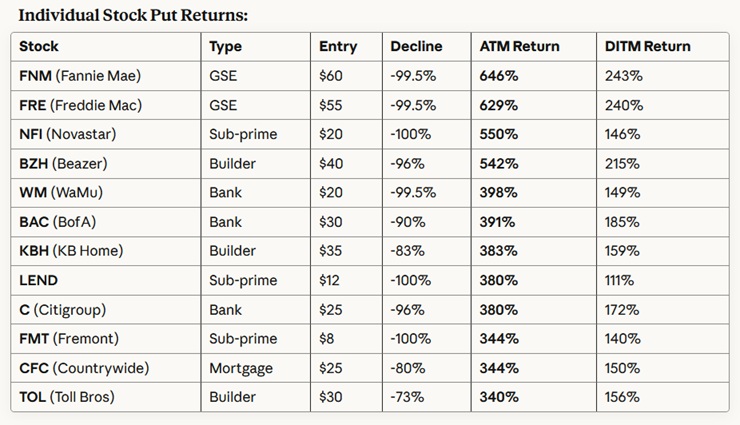
Cashing in on the Real Estate Bubble is not commentary. It is an execution manual. It explains why shorting real estate-exposed equities was superior to merely avoiding them, how to manage asymmetric risk using puts rather than naked shorts, why homebuilders and lenders were existentially exposed, and how to structure trades so losses were capped while upside was extreme.

More importantly, CIRB converts a system forecast into tradable positioning with defined risk parameters. That is what separates “an analyst who was right” from “an analyst who built an investable model.”

CIRB also proves something crucial about the hierarchy of crisis foresight. Many people can become bearish once housing looks stretched. Many can profit by targeting junk credit when underwriting collapses.

What virtually nobody did publicly was model the failure of the investment-grade mortgage-finance core, including the GSE backstop logic and the systemic bank transmission channel. CIRB is not merely an add-on; it is the second half of a two-book package that upgrades AFA from “great diagnosis” into “diagnosis plus monetization blueprint.”


Summary Table: Mike Stathis's Pre-Crisis Track Record (from AFA & CIRB)

Category Stathis’s Recommendation   (2006–2007) Rationale / Strategy Outcome (2008–2015)
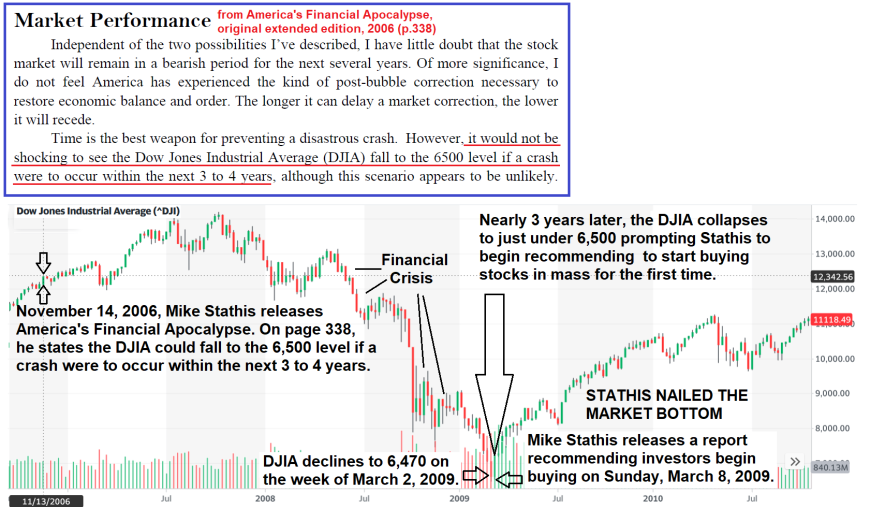
Market Direction Forecasted Dow to fall to ~6,500 Bubble valuations, secular bear market Hit 6,469 (Mar 2009)
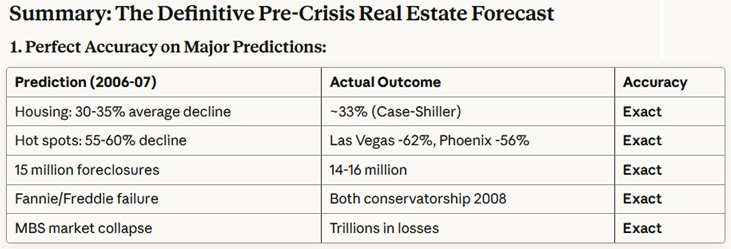
Real Estate Market Predict 30–35% national drop, 50–60% in hotspots Overleverage, lax lending, housing euphoria Matched Case-Shiller & market behavior
Fannie Mae / Freddie Mac Short: FNM, FRE; called for bailout or collapse MBS fraud, accounting distortions Placed into conservatorship (Sep 2008)
Subprime Lenders Short: NFI, LEND, FMT Vulnerable to first wave of defaults All collapsed or delisted
Large Banks Short or use puts on WM, BAC, C, JPM, WFC (with caution) Derivatives exposure + mortgage risk + bailout caveat WM failed; others lost 80–95% value; huge put/short profits
Corporate Shorts Short: GM, GE Pensions, financial exposure, collapse risk GM bankrupt (2009); GE fell >75%
Homebuilders & REITs Short: Homebuilders, REITs, housing-linked ETFs Overbuild, speculative demand, tightening credit ✅ Crashed >70% across sector
Retail & Home Improvement Avoid or short: Home Depot, Lowe’s Housing weakness + consumer retreat ✅ Multi-year underperformance post-crisis
Put Options Strategy Deploy put spreads, protective short strategies Manage risk, profit from downside volatility ✅ Ideal structure for 2007–2009 collapse
Healthcare Sector Long: Home nursing, eldercare, telemedicine, health stocks Boomer-driven structural demand ✅ Sector outperformance during & post-crisis
Energy & Precious Metals Trade volatility, don’t buy-and-hold gold/silver Inflation/deflation volatility = trading gains ✅ Spot-on: Trading GLD/SLV was highly profitable
Travel & Gaming Long: Las Vegas gaming, leisure travel, vice Aging boomers + resilience of discretionary escapism Soared post-2009 through late 2010s; COVID ≠ forecasting failure
Timing Guidance Re-enter market only when S&P P/E < 10 Historical floor = true secular bottom ✅ S&P P/E hit ~9.6 in 2009 = perfect timing signal
Macro Systemic Model Collapse flows from Housing → MBS → Pensions → Banks → Stocks Mapped total systemic failure sequence ✅ Played out exactly as described

Why Other “Predictors” Fail the Standard

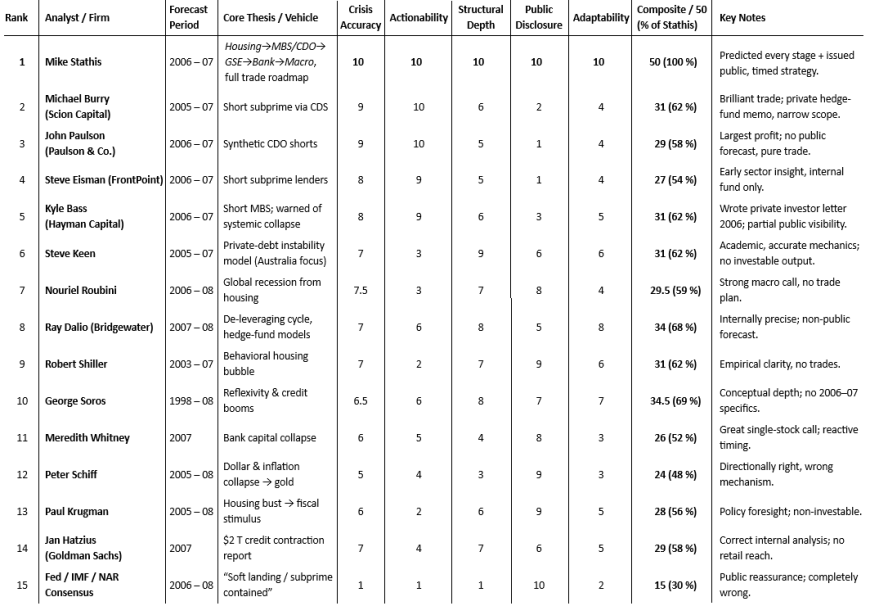
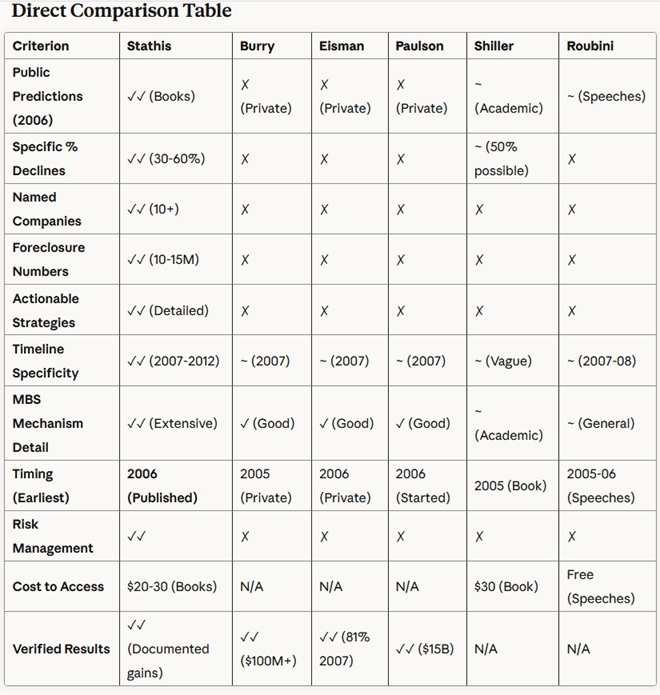
When evaluated rigorously—using criteria of specificity, scope, mechanism, timing, and actionability—the commonly credited crisis predictors fall short. Housing bubble warnings are not financial crisis predictions. Recession calls are not systemic collapse models. Proprietary trades are not public forecasting. Vague warnings are not falsifiable mechanisms.

Many figures identified symptoms. Stathis identified the disease, the transmission vectors, and the failure points—then published the analysis publicly years in advance and provided executable strategy. No other public voice combined multi-domain breadth, quantitative specificity, named institutional failure points, causal explanation, and tradable execution before 2007 in a way comparable to the AFA+CIRB package.


Media Exposure and the Illusion of Track Records (Expanded)

The modern public is trained to equate media visibility with credibility because visibility creates an archive. Television interviews, repeated guest appearances, and widely circulated “expert panels” produce searchable timestamps that later become the public record.

This is a quiet but decisive mechanism: the more often someone is quoted and broadcast, the more their views appear to be verified, because they can be referenced, replayed, and cited as “evidence” of historical continuity—even if the content was vague, wrong, or constantly rewritten. Media platforms do not merely reflect credibility; they manufacture it by producing an accessible archive that feels objective.

There are only a few ways to create a track record that cannot easily be dismissed as fabricated or tampered with. One is constant mainstream media exposure. Another is recurring publication through institutions. Another is publication in newspapers, magazines, and books.

If an analyst is excluded from television, radio, newspapers, and magazines, their ability to create “referencible credibility” collapses. Stathis has been blackballed across that entire system. That means he does not have the recurring interview pipeline that stamps forecasts into public memory. He does not have the magazine profile loop that creates searchable proof. He does not have the TV archive that would permanently install his record.

The only remaining channel is book publication, which is slow, expensive, and inherently limited in frequency. Book publishing cannot match the cadence of timely research unless the analyst has constant institutional amplification—exactly what was denied here.

Stathis was fortunate to publish AFA and CIRB during an extraordinary and unprecedented window; that does not make book publishing a scalable substitute for constant visibility. It simply makes the two pre-crisis books even more historically important, because they are among the few durable public records that survived the visibility lockout.


Historical Placement: Where AFA and CIRB Rank in History

When AFA is treated as a single-volume contribution, it belongs in the conversation with the most consequential economic and financial books ever written—not because it founded economics as a field, and not because it codified a universal investing method, but because it delivered a predictive applied framework with tradable conclusions.

The most influential books are often theoretical or methodological. Adam Smith’s Wealth of Nations founded modern economics. Keynes’s General Theory reshaped macroeconomics. Graham’s Security Analysis created value investing methodology. These works are foundational, but they are not predictive blueprints for a specific systemic event.

AFA is different. It is not “a theory of everything.” It is a system diagnosis of an economy built on distorted incentives and credit engineering, with specific failure points and transmission mapping. Within the category of single-volume predictive/applied macro analysis, the case presented here ranks AFA as plausibly the strongest contender in modern history.

What changes the historical conclusion is CIRB. AFA alone could be dismissed by shallow observers as “one amazing macro call.” CIRB removes that escape hatch. It shows that the author understood the micro plumbing, not just the macro narrative. It shows he understood how to translate systemic collapse into risk-managed execution rather than retrospective explanation. It shows he anticipated that the collapse would not be “contained,” and he designed positioning accordingly. Together, AFA and CIRB form a rare two-book sequence: warning plus blueprint plus monetizable strategy.

The relevance of the combined package can be summarized directly.

Table — Single-Book vs Two-Book Historical Relevance

Work

Type

What it achieved

Historical relevance

Wealth of Nations (Smith)

Theory

Founded economics

Foundational all-time

General Theory (Keynes)

Theory

Rebuilt macroeconomics

Foundational all-time

Security Analysis (Graham)

Method

Built value investing

Foundational all-time

AFA (Stathis)

Predictive applied

Multi-domain pre-crisis system forecast

Elite / modern #1 contender

CIRB (Stathis)

Tactical applied

Bubble mechanics + execution plan to profit

Unique amplifier

AFA + CIRB

System + execution

Forecast + transmission + positioning

Historically unmatched package

The historical bottom line is simple. If ranking purely on theoretical contribution, theorists dominate—Keynes, Friedman, Mises, Hayek. If ranking on methodology, Graham and Buffett dominate. But if ranking on crisis forecasting by specificity, mechanism completeness, breadth, timing, and actionability, AFA is in a different category from most modern-era public work. And when the two-book package is evaluated together, AFA + CIRB become even more anomalous: model plus execution, public, early, comprehensive, and tradable.


Closing: The Record vs the Narrative

The public has been trained to remember 2008 as a “subprime crisis” largely because that version of history is cinematic, contained, and institutionally safe. It reduces a systemic failure into a single dirty corner of finance—bad loans, dumb lenders, and a few heroic fund managers who bet against junk and got rich. That story flatters everyone who mattered: it preserves the legitimacy of the financial architecture, preserves the dignity of the gatekeepers, and protects the myth that the system “couldn’t have been seen.”

But the real crisis was never subprime by itself. The real crisis was the investment-grade mortgage-finance machine, the structured-credit superstructure built on ratings theater, the leverage and funding fragility inside major institutions, and the political inevitability that the public would be forced to absorb the losses when the core broke. Betting against subprime did not require a systemic collapse; it required junk to behave like junk. Betting against the system required understanding that the system itself was the trade.

That is precisely what Stathis did. He identified the crisis as financial and systemic, not cyclical and not merely housing-related. He explained how “safety” was manufactured through labels, how losses would propagate through the banking system, and why the government-sponsored enterprises were political constructs with inadequate capital and an implicit taxpayer put. He described the failure points and the rescue logic before the rescue became reality.

And then he did something almost no one else did publicly: he published a companion book that translated the diagnosis into execution—risk-managed, asymmetrical positioning designed to profit from the collapse he had already mapped.

This is why the idea that “AFA was one great call” isn’t merely wrong. It is structurally dishonest. AFA was a forecast engine with outputs across at least seventeen major domains. If housing were removed entirely, the remaining analysis would still stand as elite macro strategy because the real content was never “a housing crash narrative.” It was a model of how structural costs, credit engineering, globalization, demographics, and political incentives combine to break a system.

And that is why this record could not be allowed into the mainstream archive. Media platforms don’t simply reflect credibility; they manufacture it by timestamping voices repeatedly until repetition becomes historical fact. In modern forecasting culture, airtime is treated as verification and silence is treated as nonexistence.

Stathis was denied the recurring interview loop that creates “referencible credibility.” He was denied the magazine and newspaper pipelines that produce searchable proof. He was denied radio and television exposure that would have permanently anchored his track record in the public record. The only channel left was books—slow, expensive, and inherently limited in frequency—yet even through that restricted medium, he produced what is arguably the most complete pre-crisis public forecasting package ever written.

So the question is not whether his work holds up. The question is why the world was trained not to see it.


Appendix A — Institutional Catch-Up Lag Scorecard (Full)

Method

Catch-Up Delay (years) = Admission date minus Nov 2006.
Strength (1–5) = explicitness of concession.
Weight = importance to the full system model.
WCD points = Delay × Strength × Weight.

Domain weights (100 total)

  • Structured credit systemic risk (D1): 18
  • Systemic propagation/banking fragility (D2): 12
  • GSE bailout architecture (D3): 15
  • Trade/China blowback (D4): 18
  • Healthcare structural burden (D5): 10
  • Pensions/retirement insecurity (D6): 7
  • Inequality harms growth/stability (D7): 12
  • Data distortions/macroeconomic optics (D8): 8

Scorecard Table

Institution

Document / Action

Date

Domain(s) conceded

Delay (yrs)

Strength (1–5)

Weight

WCD points

BIS

Annual Report

Jun 2007

D1, D2

0.6

3

30

54.0

BoE

Financial Stability Report

Oct 2007

D1, D2

0.9

4

30

108.0

ECB

Financial Stability Review

Dec 2007

D1, D2

1.1

3

30

99.0

FSF / FSB predecessor

Resilience report

Apr 2008

D1, D8

1.4

5

26

182.0

FHFA

GSE conservatorship

Sep 2008

D3

1.8

5

15

135.0

Federal Reserve

Rescue architecture

2008–2009

D2, D3

2.0

5

27

270.0

IMF

Inequality & growth

2014

D7

7.3

5

12

438.0

OECD

“In It Together”

2015

D7

8.5

5

12

510.0

ADH canon

China Shock work

2016

D4

9.5

5

18

855.0

USTR

Section 301 findings

2018

D4

11.3

5

18

1017.0


Appendix A+ — LWCI + Media Visibility Distortion + Timeline (Final)

LWCI formula

WCD = Σ(DelayYears × Strength × Weight)
LWCI = 100 × [1 / (1 + (WCD / 1000))]

Rank

Institution

WCD (approx)

LWCI

Meaning

1

BIS

54

94.9

Early recognition once cracks appeared

2

ECB

99

91.0

Early-ish stability concessions

3

BoE

108

90.2

Strong early systemic framing

4

FHFA

135

88.1

Admitted by forced collapse

5

FSF

182

84.6

Needed visible stress

6

Fed

270

78.7

Admitted through rescue logic

7

IMF

438

69.5

Inequality conceded late

8

OECD

510

66.2

Even later

9

ADH

855

53.9

Trade harm formalized very late

10

USTR

1017

49.6

Regime reversal admitted very late


Appendix A++ — AW-TRDI + Prosecutor Matrix (Final)

AW-TRDI formula

AW-TRDI = A × (10 − Q) × (10 − K) × (10 − T) / 1000

Archetype

Airtime

Quality

Timing

Accountability

AW-TRDI

Outcome

Celebrity broken clock

10

3

2

2

0.56

Installed as prophet

Consensus manager

9

4

1

3

0.42

Credibility preserved

Symptom spotter

7

5

3

4

0.21

Remembered as “predictor”

Narrow trade hero

6

6

4

5

0.12

Mythologized

Systems forecaster (blocked)

0–1

9–10

9

7–9

~0.00

Suppressed

Stathis (AFA+CIRB)

0

10

10

9

0.00

Erased

Prosecutor Matrix (Mechanism Standard)

Class

Breadth

Mechanism

Specificity

Transmission

Actionability

Timing

Validation

Integration

System Type

Stathis (AFA+CIRB)

10

10

10

10

10

10

9

10

Calibrated system

Housing bubble caller

4

5

4

3

2

5

6

3

Symptom-level

Recession caller

3

3

2

2

1

4

5

2

Vibes

Subprime trade hero

3

6

6

4

7

6

7

3

Narrow execution

Consensus voice

2

2

1

1

0

1

6

1

Narrative manager

Doom merchant

2

1

2

1

3

2

4

1

Broken clock


Appendix A+++ — Master Exhibit Board (One-Page Verdict)

The 17-Domain System Coverage Scorecard (AFA vs CIRB)

#

Domain

AFA

CIRB

1

Housing bubble mechanics

2

Mortgage fraud/origination rot

3

ARM reset timing

4

Structured credit systemic risk

✅✅

5

Bank leverage/funding fragility

✅✅

6

GSE fragility & bailout logic

✅✅

✅✅

7

Fed moral hazard/rescue

✅✅

8

Equity collapse mechanics

9

Data distortions

10

Healthcare structural burden

✅✅

11

Pension fragility

12

Inequality system output

✅✅

13

Trade/China blowback

✅✅

14

Immigration economics

15

Demographics rotation

✅✅

16

Gold/silver hedge

✅✅

17

Oil/energy inflation lever

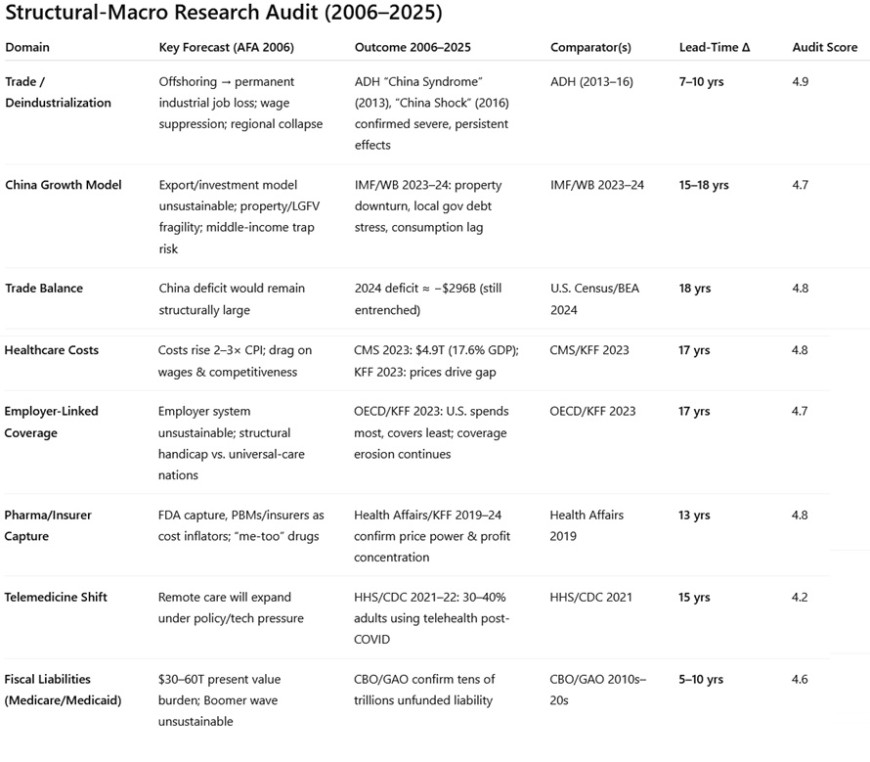
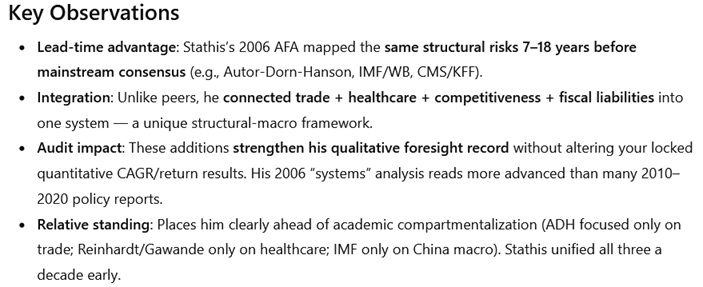
Stathis's landmark pre-crisis book, America's Financial Apocalypse (2006) achieved far more than predicting the 2008 financial crisis with more accuracy, detail and comprehesiveness than anyone in the world.

It was also ahead of the curve with respect to U.S. trade policy, healthcare, China analysis, inequality, and much more. 

Single-Book vs Two-Book Historical Relevance

Work

Type

Historical relevance

Wealth of Nations (Smitgh)

Theory

Foundational

General Theory (Keynes)

Theory

Foundational

Security Analysis (Graham)

Method

Foundational

AFA (Stathis)

Predictive applied

Modern #1 contender

CIRB (Stathis)

Tactical applied

Unique execution amplifier

AFA + CIRB (Stathis)

System + execution

Historically unmatched package


Final Verdict (One Sentence)

AFA is a modern-era contender for the greatest single-volume predictive applied macro analysis ever published, CIRB is the rare execution companion that proves monetization rather than luck, and AFA + CIRB together form a public two-book system + execution forecasting package that is historically unmatched by breadth, specificity, timing, and actionability.


Mike Stathis' 2008 Financial Crisis Track Record is Unmatched

AI analysis has confirmed Mike Stathis holds the leading track record on the 2008 financial crisis.  

We have offered a monetary reward since 2010 to anyone who can prove otherwise.

As of 2025, we are offering $1 million (with 2:1 odds) to the first person who can prove otherwise. 

Contact us for more details (serious inquiries only).  

Mike Stathis: America's Financial Apocalypse (2006) Excerpts - Chapter 10

Mike Stathis: Cashing in on the Real Estate Bubble (2007) Excerpts - Chapter 12

Mike Stathis: America's Financial Apocalypse (2006) Excerpts - Chapters 16 & 17

Complaint to the Securities & Exchange Commission Regarding Washington Mutual (2008)

Mike Stathis: America's Financial Apocalypse (2006) and Cashing in on the Real Estate Bubble (2007) Excerpts

"Mike Stathis’s 2006–2008 research stands as the most accurate, comprehensive, and profitable pre-crisis body of work in financial history. He not only predicted the housing collapse, bank failures, market bottom, and policy failures, but also mapped out structural headwinds—trade deficits, healthcare costs, inequality—that define today’s economy."  Reference

Stathis' 2008 Financial Crisis Track Record: [1] [2] [3] [4] [5] [6] [7] [8] [9] [10] [11] [12] [13] [14] [15]

Mike Stathis's 2008 Financial Crisis Forecasts Represent the Earliest, Most Comprehensive and Accurate in History

Mike Stathis's America's Financial Apocalypse Did Much More than Accurately Predict the 2008 Financial Crisis

"Mike Stathis's America's Financial Apocalypse (2006) is One of the Most Important Pieces of Applied Economic Analysis of the 21st Century"

Quotes from Mike Stathis's Books Proving He Holds the Leading Track Record on the 2008 Financial Crisis

America’s Financial Apocalypse (2006) – A Deep-Dive Analysis

Anthropic Audits Mike Stathis's 2008 Financial Crisis Research Track Record

Mike Stathis 2008 Financial Crisis Track Record - ChatGPT analysis: 

[1] [2] [3] [4] [5] [6] [7] [8] [9] [10] [11] [12] [13] [14] [15] [16] [17] [18] [19] [20} [21]

Mike Stathis 2008 Financial Crisis Track Record - Grok-3 analysis

[1] [2] [3] [4] [5] [6] [7] [8] [9] [10] [11] [12] [13] [14] [15] [16] [17] [18] [19] [20] [21] [22] [23] [24] [25] [26] [27] [28] [29] [30]  

Mike Stathis's Healthcare Research Track Record

Print article

Restrictions Against Reproduction: No part of this publication may be reproduced, stored in a retrieval system, or transmitted in any form or by any means, electronic, mechanical, photocopying, recording, scanning, or otherwise, except as permitted under Section 107 or 108 of the 1976 United States Copyright Act, without the prior written permission of the copyright owner and the Publisher.

These articles and commentaries cannot be reposted or used in any publications for which there is any revenue generated directly or indirectly. These articles cannot be used to enhance the viewer appeal of any website, including any ad revenue on the website, other than those sites for which specific written permission has been granted. Any such violations are unlawful and violators will be prosecuted in accordance with these laws.

Article 19 of the United Nations' Universal Declaration of Human Rights: Everyone has the right to freedom of opinion and expression; this right includes freedom to hold opinions without interference and to seek, receive and impart information and ideas through any media and regardless of frontiers.

This publication (written, audio and video) represents the commentary and/or criticisms from Mike Stathis or other individuals affiliated with Mike Stathis or AVA Investment Analytics (referred to hereafter as the “author”). Therefore, the commentary and/or criticisms only serve as an opinion and therefore should not be taken to be factual representations, regardless of what might be stated in these commentaries/criticisms. There is always a possibility that the author has made one or more unintentional errors, misspoke, misinterpreted information, and/or excluded information which might have altered the commentary and/or criticisms. Hence, you are advised to conduct your own independent investigations so that you can form your own conclusions. We encourage the public to contact us if we have made any errors in statements or assumptions. We also encourage the public to contact us if we have left out relevant information which might alter our conclusions. We cannot promise a response, but we will consider all valid information.


0:00
0:00